Hand-Finished Milanese Tailoring: A Close Reading of the Button
The shank, the gimp, and the small confidences that separate a real 1980s Italian jacket from a copy.

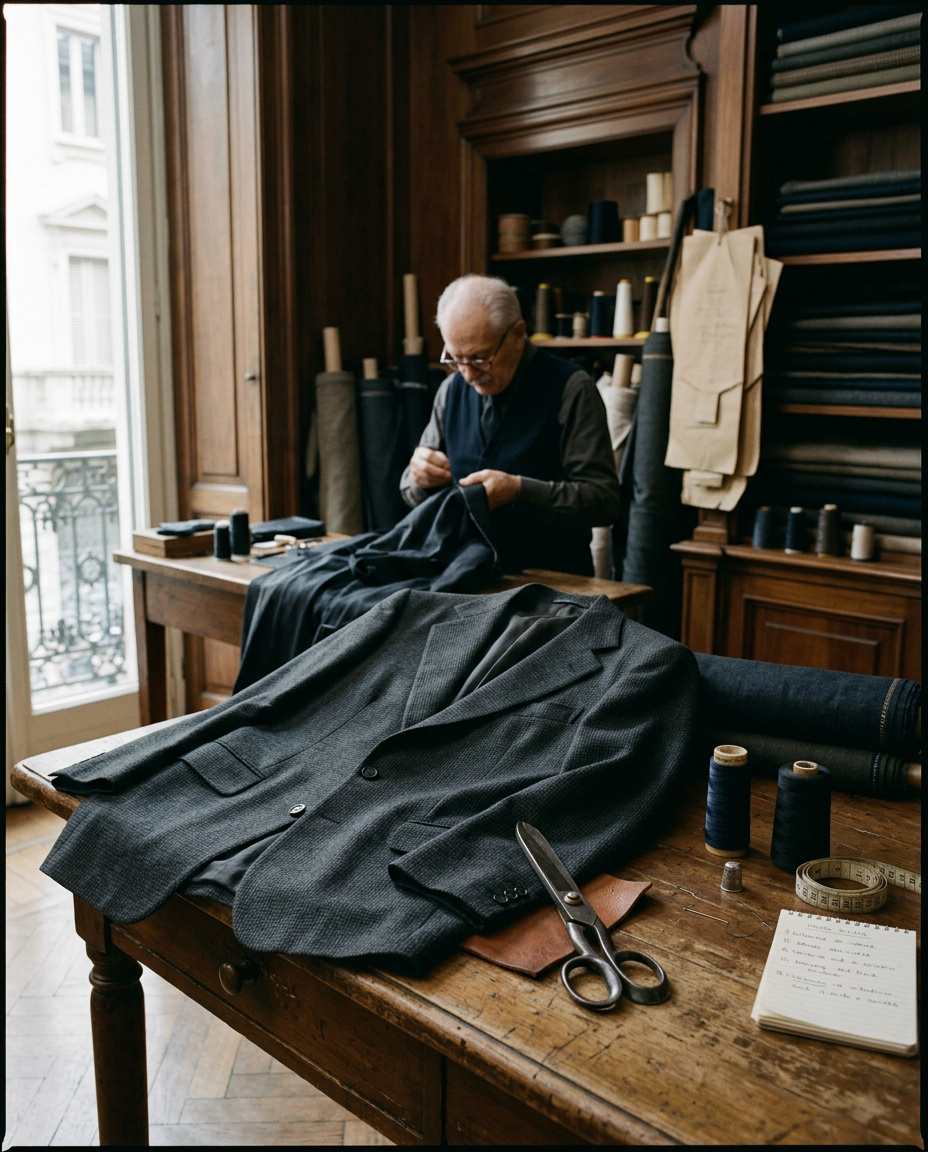
A real Milanese jacket from the great 1980s tailoring houses — early Armani, Caraceni's Milan atelier, Brioni's pre-licensing pieces — telegraphs its quality at the button. Look at the cuff: four real buttonholes, each hand-stitched, slightly asymmetrical, with a fine gimp running inside the stitch that gives the hole a three-dimensional ridge under raking light. The buttons themselves are real horn or mother-of-pearl, each one slightly different in figure, sewn with a wrapped silk shank that lets the button sit half a millimetre off the cloth.
The construction follows Neapolitan principles softened for the Milanese silhouette. The shoulder is built with a small spalla camicia — a shirt-shoulder pleat at the sleeve head that lets the sleeve roll naturally. The chest piece is hair canvas, pad-stitched by hand at a 45-degree angle in matching silk thread. The lapel rolls to the second button on a soft curve, never a sharp crease. The lining is bemberg, attached with a slip-stitch that allows it to ease independently of the cloth.
Fabric tells the period. Early 1980s Milanese tailoring favoured Loro Piana super 100s wools, drago canvas, and the lighter Carlo Barbera flannels. Look at the selvedge of the lining where it meets the seam — a properly finished Italian jacket will show a tiny hand-felled overlock, not a serged industrial edge. The label is woven, sewn in by hand with three or four stitches, never glued.
A jacket like this, even at thirty years old, will still drape better than almost anything you can buy new. The construction is the reason.
Keep reading