← The JournalIssue · May 2026
The Vintage Guide · global

Tokyo's Vintage Charm: A Fusion of Heritage and Modern Style

Tokyo's vintage fashion scene thrives on a delicate balance, weaving traditional Japanese aesthetics with global trendsetting influences to create a unique sartorial landscape.

global· JP· Tokyo
Tokyo's Vintage Charm: A Fusion of Heritage and Modern Styleglobal · Tokyo
Tokyo

Tokyo's Vintage Charm: A Fusion of Heritage and Modern Style

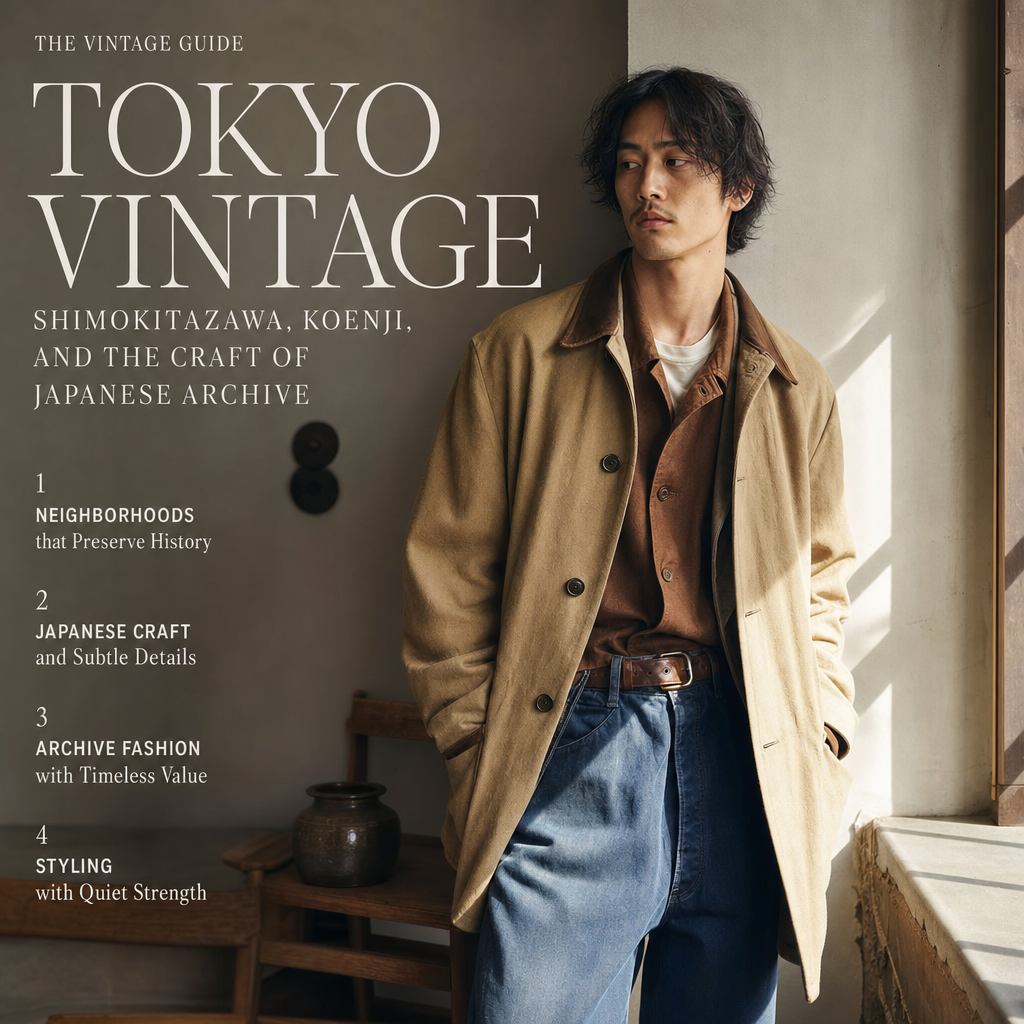
The first impression of Tokyo is one of exhilarating paradox. It is a city of crystalline futures, where neon signs bleed into the rain-slicked asphalt of Shibuya Crossing and bullet trains slice through the skyline with silent precision. Yet, wander just a few steps off these main arteries, into the labyrinthine alleyways of a neighbourhood like Shimokitazawa or Koenji, and the city's pulse slows. Here, another Tokyo reveals itself—one that treasures the patina of age, the story held in a seam, and the enduring beauty of things made to last. This is the heartland of Tokyo's vintage scene, a sartorial ecosystem so sophisticated and deeply ingrained in the culture that it operates less like a trend and more like a philosophy. It is a world built on a profound respect for history, a meticulous eye for detail, and an almost revolutionary act of personal curation in the face of globalised fast fashion.

In this sprawling metropolis, the act of dressing in second-hand clothing transcends mere nostalgia or budget-consciousness. It is a dialogue with the past, a conscious weaving of narratives. This is a culture that has, for centuries, cultivated an appreciation for objects that bear the marks of time and use—a philosophy encapsulated in the aesthetic of wabi-sabi, which finds beauty in imperfection and transience. To the Tokyo vintage enthusiast, a perfectly faded pair of 1960s Levi's 501s, their denim softened to the texture of flannel, is not just old; it is a completed object, its story fully told. This reverence for longevity and craftsmanship forms the bedrock of the entire scene, creating a powerful counter-narrative to the disposable cycles that dominate modern apparel.

The Global Archive, Reimagined

Walk into any well-regarded vintage store from Naka-Meguro to Harajuku, and you are not just entering a shop; you are entering a meticulously curated archive. The DNA of Tokyo's vintage scene is inextricably linked to a deep and scholarly obsession with twentieth-century American and European style archetypes. This is the phenomenon of Ametora, or "American Traditional," a post-war emulation of Ivy League style that has since evolved into a foundational element of Japanese menswear. You will find racks of impossibly well-preserved Brooks Brothers oxford cloth button-downs, collegiate sweatshirts from the 1970s with perfectly cracked logos, and heather grey loopwheel hoodies that feel more substantial than anything manufactured today. This is not imitation; it is a form of cultural preservation, often executed with a rigour that surpasses that of its origin country.

This archival impulse extends far beyond the campus. There is a deep, almost academic reverence for military surplus and classic workwear. The rails are heavy with the olive drab of M-65 field jackets, the dark indigo of French chore coats, and the rugged twill of US Navy CPO shirts. Each piece is valued for its utilitarian design, its robust construction, and the history embedded in its very fibres. But the true genius of Tokyo style lies not in faithful reproduction, but in radical recontextualisation. A young creative in Daikanyama might pair a sun-beaten Vietnam-era jungle jacket with wide-legged, avant-garde trousers from Comme des Garçons, or layer a delicate, antique lace blouse under a thick, patinated leather biker jacket. It is a constant, dynamic fusion—where the ghosts of Western subcultures are summoned and redressed in a distinctly Japanese silhouette.

The result is a look that feels both timeless and utterly contemporary. It's a sartorial language where a vintage piece is not the endpoint, but the foundational grammar. It's the anchor of authenticity in an outfit that might otherwise be composed of cutting-edge runway pieces. This effortless synthesis of old and new, utility and high fashion, is what makes Tokyo's street style a global benchmark. It demonstrates a level of style literacy that is both deeply personal and culturally resonant, transforming the wearer from a mere consumer into a curator of their own identity.

A Tale of Three Neighbourhoods

To truly understand the texture of Tokyo's vintage landscape, one must navigate its key territories, each with its own distinct personality and sartorial specialisation. The journey for many begins in Shimokitazawa, a low-rise, bohemian enclave in the west of the city. Affectionately known as "Shimokita," its narrow, winding streets—too small for most cars—create a village-like atmosphere, a world away from the verticality of Shinjuku. The vintage shopping here is dense, accessible, and wonderfully chaotic. Shops are often tiny, piled high from floor to ceiling with a dizzying mix of 1970s prairie dresses, 1990s band T-shirts, colourful knitwear, and an endless sea of denim. Shimokitazawa is the id of Tokyo vintage: expressive, eclectic, and unpretentious. It's where you might unearth a forgotten treasure for a handful of yen, the air thick with the faint, sweet smell of old cotton and the sound of an overhead train rattling the windows.

If Shimokita is the bohemian heart, then Harajuku is the high-fashion brain. While the main Takeshita Street caters to a more kawaii-centric, fast-fashion crowd, its backstreets—the area known as Ura-Harajuku—are a different world entirely. This is the historic epicentre of the subcultures that put Japanese street style on the global map. The vintage here is less about serendipitous discovery and more about surgical precision. The stores are sleeker, more akin to galleries, and their contents are treated with the reverence of museum artefacts. This is the realm of archive fashion. Here, you will find grails from the most influential collections of the '90s and early '00s: a bonded bomber jacket from Helmut Lang's definitive Autumn/Winter 1999 collection, a piece of deconstructed tailoring from early Martin Margiela, or a rare graphic T-shirt from the Ura-Harajuku heyday of Number (N)ine or Undercover. This is where global collectors and design teams make their pilgrimage, seeking inspiration and the very garments that have shaped the last thirty years of fashion.

For the true specialist, however, the path inevitably leads to Koenji. Grittier and less polished than its more famous counterparts, Koenji is arguably the city's most authentic vintage hub, a place for purists. It is a neighbourhood organised by obsession. One shop might specialise exclusively in pre-1970s European workwear, another in 1950s rockabilly attire, and a third in an encyclopedic collection of military garments from every conceivable conflict and country. The punk and rock scenes are alive and well here, reflected in stores dedicated to perfectly worn-in leather jackets and shredded, authentic punk paraphernalia. To shop in Koenji is to engage with obsessives, to learn the minute differences between eras of production, and to appreciate clothing not just as fashion, but as historical documentation.

The Philosophy of the Mend

Beyond the curation of Western styles, a deeper, indigenous philosophy permeates the Tokyo vintage scene—one that elevates the garment beyond its material form. It is the artful practice of mending. In a culture that has historically practiced boro (the act of mending and patching textiles over generations) and sashiko (a form of decorative reinforcement stitching), a repair is not a flaw to be hidden. It is an enhancement, a mark of character, and a testament to the object's journey. A pair of jeans with a beautifully executed sashiko patch over the knee tells a story of care and continuation. It is a visible manifestation of the principle of *mottainai*—a Buddhist term conveying a sense of regret concerning waste.

This philosophy has been powerfully reinterpreted in the context of high fashion. The work of Japanese designers like Rei Kawakubo and Yohji Yamamoto often plays with ideas of deconstruction, imperfection, and the beauty of the unfinished. This aesthetic sensibility primes the Tokyo consumer to see the value in a garment that shows its age. A tear is not necessarily damage; it is an intervention. A fade is not a flaw; it is a unique patina. This outlook transforms the act of buying vintage from a simple transaction into a form of active participation in the garment's life. You are not its first owner, and you may not be its last. You are merely its current custodian.

This perspective offers a profound lesson for a world grappling with the environmental and ethical consequences of its clothing addiction. The Tokyo vintage scene is not a trend-driven, Instagram-fuelled flash in the pan. It is a deeply embedded, sustainable circular economy that has been operating for decades, long before "sustainability" became a corporate buzzword. It is a model built on knowledge, care, and a respect for the tangible and intangible value of things that are made well.

As the sun sets over the city, casting long shadows between the buildings of Shibuya, a new generation of Tokyoites continues this tradition. They move through the metropolis clad in their curated histories—a patchwork of decades, continents, and subcultures. In their careful assembly of a 1980s Issey Miyake Plantation coat over a 1950s American sweatshirt and perfectly tailored contemporary trousers, they are doing more than just getting dressed. They are keeping a living archive, demonstrating that style is not about what is new, but about what endures. In Tokyo, the past is not a foreign country; it is the very fabric from which the future is cut.

Words · The Vintage Guide editorial desk · 19 May 2026
tokyovintage fashionjapanese styleharajukushimokitazawasustainabilityfashion history