London's Vintage Soul: A Journey Through Time and Style
London, a city steeped in history, offers a vibrant tapestry of vintage fashion that continues to enchant and inspire, reflecting its enduring cultural legacy.
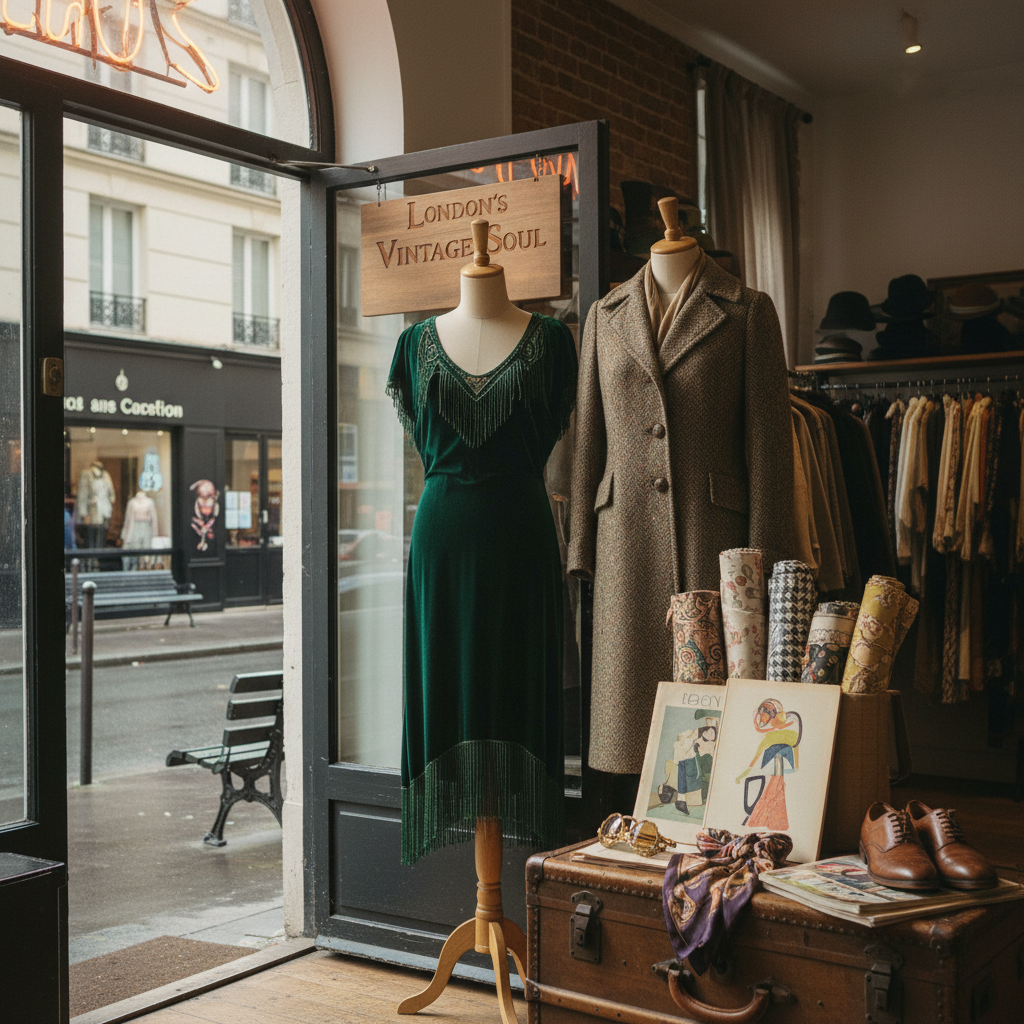
## London's Vintage Soul: A Journey Through Time and Style
There’s a specific alchemy that happens when you step off a Tube train at Bethnal Green on a Saturday morning, the air thick with the scent of fried onions from a nearby market stall and the distant thrum of a vintage rockabilly band tuning up. London doesn’t just wear its history; it lives in it, layer upon layer, like a perfectly broken-in leather jacket that smells of rain, cigarettes, and old paper. This is the city where a 1920s beaded flapper dress can sit on a rail next to a 1990s Moschino power suit, and neither feels out of place. For the discerning eye, London’s vintage scene isn’t about nostalgia—it’s about the violent, beautiful collision of eras, a curated chaos that tells you more about who we are now than any fast-fashion drop ever could.
The Sacred Geography: Neighborhoods as Eras
To understand London’s vintage soul, you must first understand its geography as a timeline. Brick Lane is the obvious starting point, but treat it as a gateway, not a destination. The Sunday UpMarket at 91 Brick Lane is a sensory overload: the hiss of a steam press, the clatter of vinyl crates being flipped, the thick Turkish coffee aroma from the café in the corner. Here, you’ll find the 1970s suede fringe jackets that scream “I saw Almost Famous one too many times,” but also the real deal—original 1960s Mary Quant shift dresses, stiff with age, their geometric prints still sharp as a fresh razor cut.
But walk five minutes east to Bethnal Green, and the tone shifts. The Bethnal Green Vintage Market (the one under the railway arches on Cygnet Street) is a hushed, almost sacred space. The light is dim, filtered through grimy Victorian glass; the floor is concrete worn smooth by decades of feet. This is where the dealers come—the ones who don’t need to sell you a story because the clothes speak for themselves. You’ll find a rack of 1940s rayon dresses, their seams perfectly pressed, a faint ghost of lavender still clinging to the fabric. This is where you go for the real 1930s bias-cut slips, not the reproductions. A woman in a severe black dress and horn-rimmed glasses will silently hand you a 1950s Dior copy, and you’ll feel the weight of the crinoline like a promise.
For the true 1920s-30s obsessive, the pilgrimage must go west to Portobello Road. But skip the Saturday tourist crush. Go on a Friday, when the arcade dealers are setting up and the air is still crisp. The Portobello Antique Market’s lower level is a catacomb of glass cases, each one a time capsule. Here, you’ll find the art deco brooches, the Bakelite bangles still warm from the display case, and the 1920s drop-waist dresses that have the faintest yellowing under the arms—a mark of authenticity, not damage. This is the neighborhood for the haute vintage, the pieces that cost more than your rent but will outlive your grandchildren.
The Shops That Matter
Don’t waste your time on the Instagram-bait shops that sell 1990s band tees for £80. The real curators are quieter, more peculiar. Beyond Retro on Cheshire Street is a known quantity, but its Soho outpost on D’Arblay Street is the one to hit. The staff are sartorial historians in all-black uniforms. They’ll pull a 1980s Yves Saint Laurent Rive Gauche blazer from a pile and hold it up to the light, showing you the frayed silk lining as a badge of honor. The pricing is aggressive, but the curation is immaculate—a mix of 1970s denim jackets with hand-embroidered patches, 1990s Helmut Lang bodysuits, and the occasional 1950s crocodile handbag that smells of old leather and envy.
For the 1970s obsessive, The Vintage Showroom in Covent Garden is a pilgrimage site. It’s part museum, part emporium, with racks of 1970s Italian knitwear in ochre and rust, the wool still soft despite the decades. The shop’s owner, a man with a magnificent silver beard and a voice like gravel, will tell you about the provenance of a 1970s Ossie Clark dress as if recounting a family legend. “That one,” he’ll say, tapping a glass case, “was worn by a model at a party in Chelsea in 1973. She spilled champagne on it. You can still see the mark.” He’s not wrong. The faint stain is there, a ghost of a party you’ll never attend.
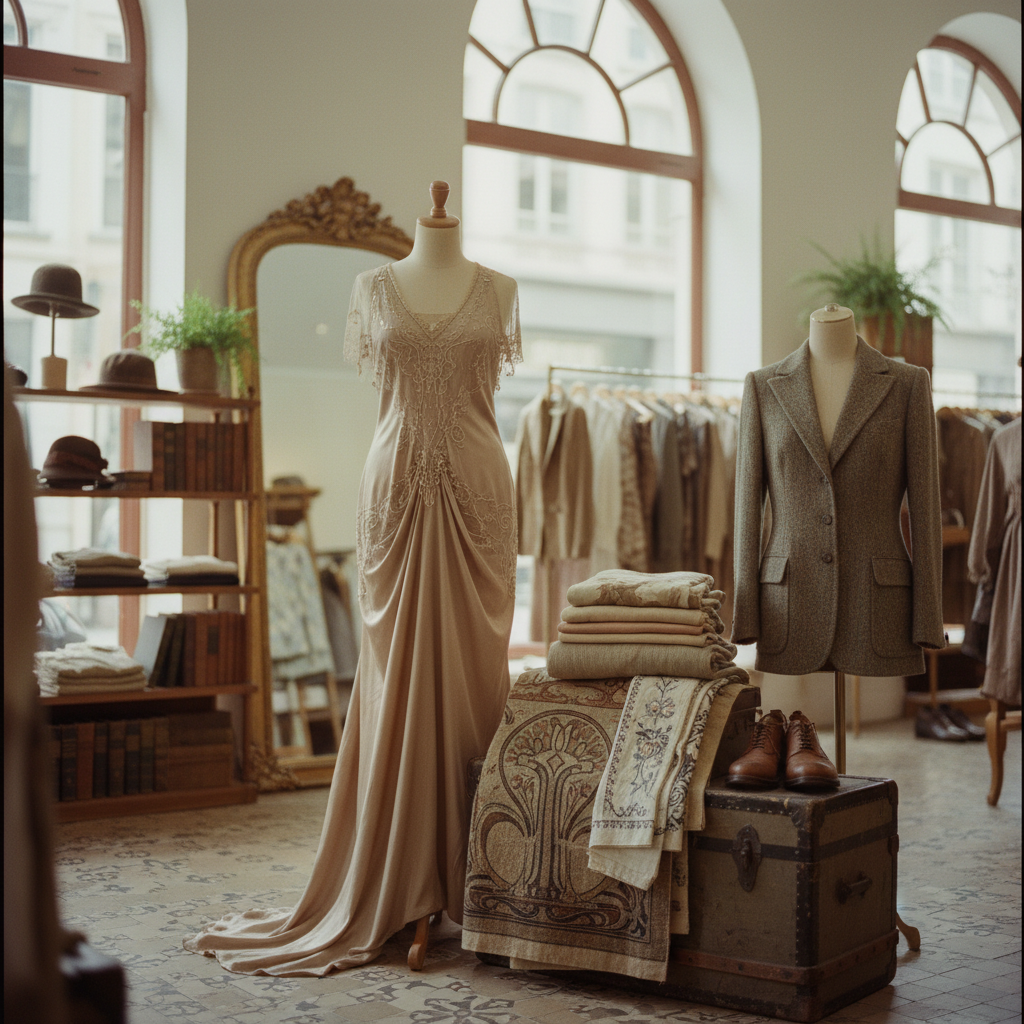
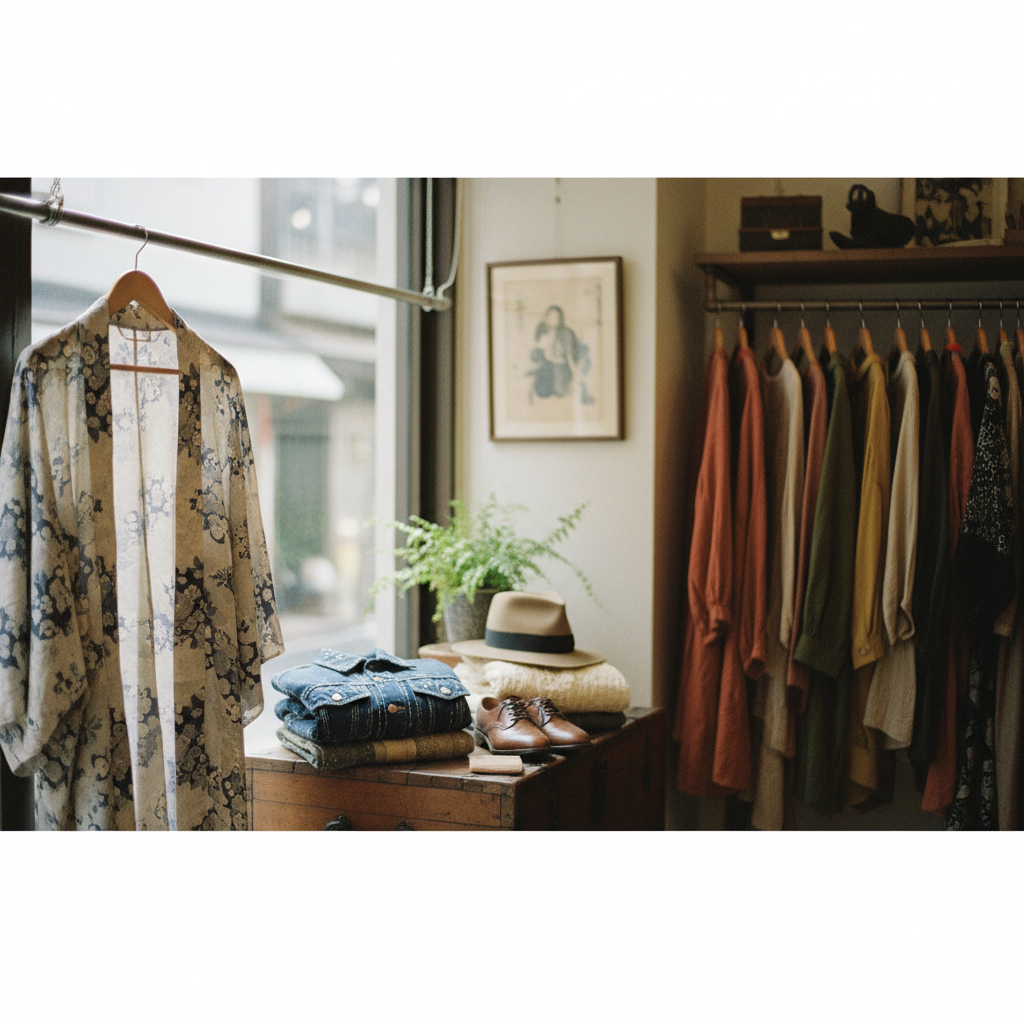
Then there’s Cenci on Camden Passage in Islington, a narrow, cream-walled space that feels like stepping into a 1960s atelier. The owner, a Japanese woman with impeccable taste, sources exclusively from the 1920s to the 1970s, with a focus on British and French couture. The racks are sparse, each piece a considered choice: a 1950s Dior wool coat in charcoal grey, the buttons like polished coal; a 1930s silk robe from a Parisian maison, the embroidery so fine it looks like watercolor. This is not a shop for browsing; it’s a shop for a conversation, a slow, deliberate hunt.
The Cultural Why: Why We Dig
Why do we do this? Why spend a Sunday morning elbow-deep in a rail of 1980s power suits, our fingers stained with dust, our noses filled with the smell of mothballs and old dreams? Because vintage in London is a rebellion against the tyranny of the new. It’s a middle finger to the algorithm that tells you to buy the same Zara blazer as everyone else. When you wear a 1970s Ossie Clark dress, you’re not just wearing a garment; you’re wearing a story, a party, a night that ended with a champagne stain and a laugh. You’re wearing a moment that can never be repeated, and in doing so, you make it yours.
There’s also a deep, almost spiritual connection to the city’s history. London has been a fashion capital since the 1960s, and its vintage is a living archive. A 1950s tweed suit from a Savile Row tailor? That’s a piece of the city’s post-war austerity, its quiet dignity. A 1970s punk leather jacket with safety pins still in the lapels? That’s the sound of the Sex Pistols at the 100 Club, the smell of sweat and rebellion. A 1990s Alexander McQueen “bumster” trousers? That’s the moment when London fashion became global, when a working-class boy from Stratford turned the world on its head. To wear these things is to claim a piece of that history, to wear the city’s soul on your sleeve.
And let’s not pretend it’s purely altruistic. Vintage is a flex. It’s knowing that your 1960s Biba dress is worth more than a thousand fast-fashion knockoffs, that your 1980s Comme des Garçons jacket was made in a time when clothes were made, not assembled. It’s the quiet satisfaction of someone asking, “Where did you get that?” and knowing that the answer—a rainy Thursday in Hackney, a dealer who didn’t know what they had—is a story they’ll never have.
The Curated Edit: What to Buy, Where, and How
You need a strategy. London’s vintage is a labyrinth, and if you go in without a plan, you’ll leave with a 1990s McDonald’s uniform and a headache. Here’s your edit.
The 1920s-30s Sequin Dress: For the truly dedicated. Look at Portobello Road’s lower arcade or Grays Antique Centre just off Bond Street. The sequins will be tarnished, the silk backing fragile. That’s the point. Pay up to £300 for a genuine piece. Wear it with bare legs and a 1920s fringe headband, or throw it over a black turtleneck and jeans for a modern twist.
The 1960s Mary Quant Shift: Found in abundance at Bethnal Green Vintage Market and Beyond Retro. Look for the geometric prints in orange, brown, and cream. A genuine Quant label will have a tiny “M.Q.” on the tag. Expect £80-£150. Pair it with white patent leather boots and a geometric pendant.
The 1970s Ossie Clark Dress: The holy grail. The Vintage Showroom is your best bet, but be prepared to spend £400-£800. Look for the signature bias-cut jersey, the floral prints, the tiny “Ossie Clark” label. This is a dress for a party, for a night that ends with a champagne stain. Wear it with a 1970s suede wedge heel and a gold chain belt.
The 1980s Power Shoulder Blazer: The ultimate armor. Beyond Retro and Cenci have the best selection. Look for oversized, sharp-shouldered silhouttes in black, cream, or a bold primary color. Brands to hunt: Thierry Mugler, Claude Montana, YSL. Expect £60-£150. Wear it with high-waisted trousers and a simple white shirt, or over a 1990s slip dress for a high-low contrast.
The 1990s Helmut Lang Bodysuit: The minimalist’s dream. Beyond Retro’s Soho outpost is a goldmine. Look for the matte black jersey, the cut-out backs, the tiny “H. Lang” tag. Expect £80-£120. Wear it under a 1980s blazer, or with a 1970s denim skirt for a layered era look.
The 1950s Dior Wool Coat: The investment piece. Cenci in Islington is the place. Look for a charcoal or navy wool, with a fitted waist and a full skirt. The lining will be silk, the buttons polished. Expect £500-£1,000. This is a coat for life, for the rain, for the city that never stops.
The 1970s Italian Knitwear: The sleeper hit. The Vintage Showroom and Portobello Road have racks of it. Look for the chunky, ribbed sweaters in rust, ochre, and forest green. Brands like Missoni, with their zigzag patterns, are the holy grail. Expect £100-£250. Wear it with 1970s flared jeans and a pair of Frye boots.
The Final Word: The best vintage in London is not the piece that’s trend-proof or the one that will appreciate in value. It’s the one that makes you stop breathing when you find it. That 1920s beaded bag with a broken clasp, the 1970s suede jacket with a tear in the lining, the 1990s slip dress with a faint cigarette burn—these are the pieces that will outlive you, that will carry your stories into the next decade, the next century. London’s vintage soul is not for the faint of heart. It’s for the hunters, the obsessives, the ones who know that the past is not a foreign country—it’s just a very good shop on a rainy afternoon.
Keep reading